
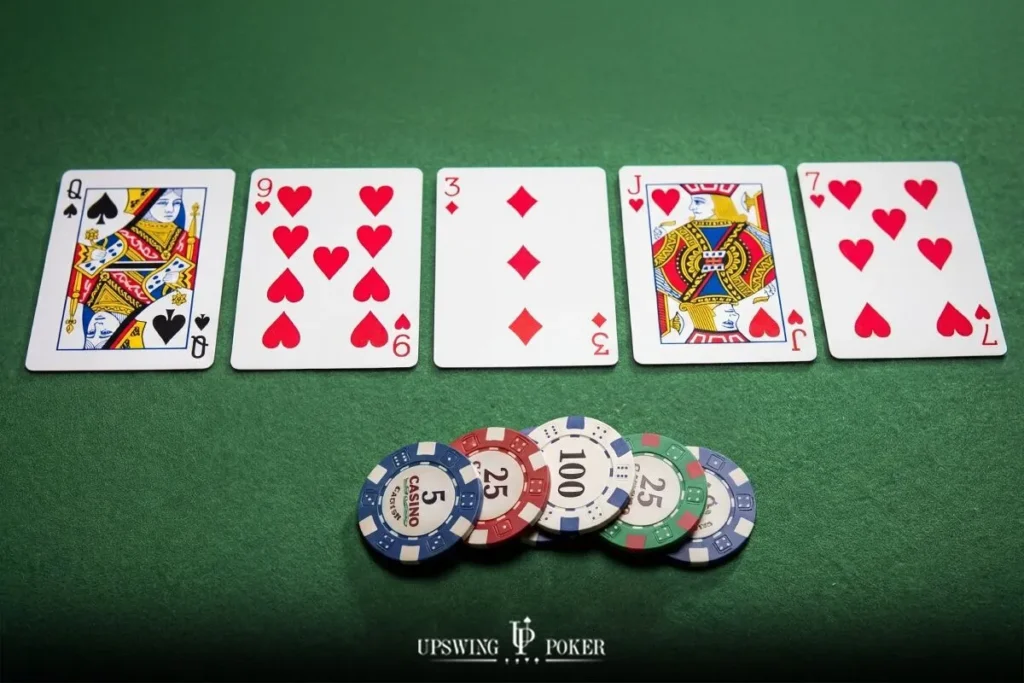
The river block bet is a solver-derived discovery that revolutionized poker strategy.
I will break down why that is and how it helps you make more money at the poker table. I will start with a hand example, then dive into the theory behind the strategy, and finally tie it together to find the optimal solution.
Let’s dive in!
Laying the Scenario: To Bet or Not to Bet?

Why Do We Bet?
Let’s start with the basic premise. Why do we even bet?
There are a few different ways to approach this, but for our purposes, we will focus on the two main reasons:
- We bet because we are likely to win the pot at showdown when called.
- We bet because we expect our opponent to fold more than he should, thus generating a profit with a hand that doesn’t win often enough at showdown.
This brings us to the next question:
Why Do We Bet Different Sizes?
Different bet sizes create different mathematical constraints.
Smaller bets require the opponent to defend with a larger part of his range to prevent bluffs from becoming profitable.
Conversely, bigger bets require the opponent to defend with a smaller part of his range to prevent bluffs from becoming profitable.
This is known as the minimum defense frequency (MDF) concept, and it is one of the pillars of poker strategy.
The formula is as follows:
MDF = 1 – (Bet / (Bet + Pot))
This means that if you face a 50% pot bet, your MDF is equal to 1 – (0.5 / (0.5 + 1)). This is equal to 0.67 or 67%, so you need to continue with 67% of your range to prevent the opponent from bluffing you profitably.
Beyond the bluffing implications, bet size affects how thin you can go for value as well. We know this intuitively: the smaller you bet, the weaker the hand that the opponent is willing to call with, and vice versa.
While intuition is not always correct, in this case, the mathematics of the game corroborate it.
This is how the minimum defense frequencies look against different bet sizes:

We can see here that the smaller the bet you encounter, the wider you have to defend to prevent the opponent from having a profitable bluff.
Pro Note: The MDF concept only applies when the opponent has enough low-equity hands in his range to be able to overbluff. There are a variety of situations where, even in theory, the opponent simply doesn’t have enough very weak hands to overbluff with.
In addition, sometimes his bluffs will have high EV in the checking line. In such cases, it is optimal to over-fold compared to MDF.
Read More